Machine Learning Vs Generative AI Jobs: What’s The Difference?
26 Jan, 20266 minutesNavigating the 2026 AI Jobs Market In 2026, the distinction between machine learning a...


Navigating the 2026 AI Jobs Market
In 2026, the distinction between machine learning and generative AI jobs hinges on output: ML roles focus on predictive modelling and structured data patterns, while GenAI jobs prioritise content creation, LLM orchestration, and RAG architectures within the tech hiring market.
The difference between machine learning jobs and generative AI jobs has shifted from a technical curiosity to a core consideration in AI and tech recruitment strategies. As we move through 2026, the "AI" umbrella has expanded so rapidly that hiring managers and candidates alike often find themselves lost in a sea of overlapping buzzwords.
At MRJ Recruitment, we’ve seen a 45% year-on-year increase in requests for specialised AI talent. However, the most successful placements occur when both the employer and the candidate understand the nuanced technical split between "traditional" machine learning and the exploding world of Generative AI. Whether you are looking for AI and machine learning jobs or trying to fill a high-stakes genai engineer job vacancy, clarity is your greatest competitive advantage.
What Is Machine Learning? (The Foundation of Prediction)
At its core, Machine Learning (ML) is about patterns and predictions. In a recruitment context, ML roles are the "engine room" of the data economy. These professionals build systems that look at historical data to predict future outcomes, whether that’s a customer’s likelihood to churn or a bank’s exposure to fraudulent transactions.
Defining Machine Learning Roles in Organisations
When we partner with clients for machine learning jobs, we typically look for candidates who excel in statistical modelling and data engineering. The roles generally fall into three buckets:
- ML Research Scientists: Focused on the "why" and "how" of new algorithms.
- Machine Learning Engineers: The architects who take a model from a Jupyter notebook and scale it into a production environment.
- Data Scientists: The storytellers who use ML to extract actionable business insights.
The demand for Python hiring remains the common thread here. While new languages emerge, Python's ecosystem (PyTorch, TensorFlow, scikit-learn) remains the non-negotiable standard for ML excellence.
What Is Generative AI? (The Evolution of Creation)
If traditional ML is about analysing existing data, Generative AI (GenAI) is about creating new data. From text and code to images and synthetic data, GenAI has shifted the focus from prediction to production. In the tech hiring market, this has created an entirely new category of AI engineer jobs.
Why Are GenAI Engineer Jobs Growing?
The explosion of GenAI engineer jobs is driven by the move from "AI pilots" to "AI production." In 2026, companies aren't just playing with ChatGPT; they are building proprietary systems using LLM orchestration and RAG (Retrieval-Augmented Generation) architecture.
According to recent industry data, over 80% of enterprises will have deployed GenAI-enabled applications by 2026. This has triggered a massive skills-gap analysis for HR leads, as they realise that a traditional ML background doesn't always translate perfectly into the world of prompt engineering and latent space manipulation.
For a deeper look at compensation trends, our USA AI engineering salary benchmarks for 2026 highlights how GenAI roles are being valued across global markets.
Key Differences Between Machine Learning Jobs and GenAI Jobs
Understanding the difference between machine learning jobs and generative AI jobs starts with looking at the day-to-day responsibilities of each role.
Tooling and Responsibility
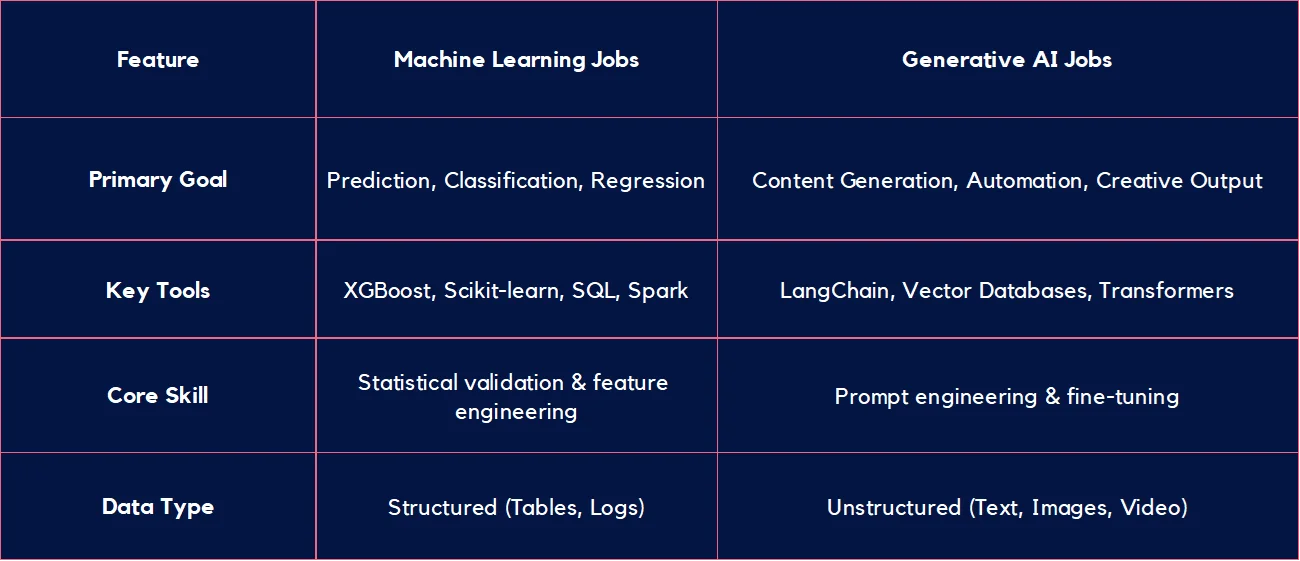 Table: Key differences between machine learning jobs and generative AI jobs, including primary goals, tools, core skills, and data types
Where Specialisation Is Emerging in Senior AI Leadership Roles
We are seeing a clear trend in executive search tech where leadership roles are now split between “Head of Data Science” (ML-focused) and “Head of AI Transformation” (GenAI-focused). While both roles share a strong mathematical and engineering foundation, the stakeholder expectations placed on them are increasingly different.
ML leadership roles are typically anchored in Finance or Operations, where success is measured through efficiency, accuracy, and long-term model performance. In contrast, GenAI leadership roles more often sit within Product or Marketing, with a focus on innovation, speed to market, and enabling new capabilities across the business.
Senior machine learning jobs continue to face salary compression, a challenge we explore in more detail in our 2026 strategy guide for ML engineers.
For AI recruitment, this shift means greater precision is required at the leadership level. Clearly defining remit, reporting lines, and success metrics is now critical to securing the right expertise and avoiding costly misalignment in senior AI hires.
How AI Teams Are Evolving: The Rise of Hybrid AI Engineers
The most successful organisations in 2026 aren't choosing one over the other; they are building hybrid teams. We’ve observed that the most resilient AI jobs are those that bridge the gap.
A "Hybrid AI Engineer" is the new gold standard. These individuals can build a traditional recommendation engine (ML) but also wrap it in a conversational interface (GenAI). This requires a deep understanding of MLOps alongside the practice of automating the deployment and monitoring of models.
Navigating these complex role definitions is what we do best. If you're struggling to define your next hire, explore our specialist recruitment services to see how we can streamline your search.
Why the Distinction Matters for AI Recruitment
For Candidates: Positioning for the 2026 AI Job Market
- Diversify your stack: Don't just list "AI". Specify your experience with RAG, vector embeddings, or traditional Bayesian networks.
- Showcase "Production" Experience: Employers want to see how you handled model drift or LLM hallucinations in a live environment.
- Benchmark your value: Stay updated on developer salaries UK to ensure your compensation matches your specialised niche.
For Employers: How to Avoid “Hype Hiring” AI Engineers
- Clarity in Job Titles: Don't just advertise for an "AI Engineer." Be specific about whether you need neural network optimisation or a custom chatbot.
- Invest in Talent Pipelines: Use a talent pipeline approach to nurture specialists. The best AI talent is often headhunted rather than found on job boards.
FAQ
What is the salary difference between ML and GenAI jobs in the UK?
In the current tech hiring market, GenAI engineer jobs often command a 10-15% premium. However, senior machine learning jobs in high-stakes sectors like finance still offer some of the highest developer salaries UK, often exceeding £120k.
Do I need to know Python for both roles?
Yes. Whether you are pursuing ai jobs in ML or GenAI, Python hiring data shows it is the dominant language.
Can a Machine Learning Engineer easily switch to Generative AI?
The transition is common but requires upskilling in patterns like managing token costs and RAG pipelines.
Which field has more long-term job security?
Traditional ML is more embedded in core business operations, while GenAI is currently in a high-growth phase. For maximum security, we recommend a "T-shaped" skill set.
Your Next Step: Mastering AI Recruitment in 2026
The difference between machine learning jobs and generative AI jobs will continue to evolve. Staying ahead requires the right strategic partner.
3-Step Checklist for AI Success:
- Audit Your Current Team: Perform a skills gap analysis to see if your current data team has "GenAI literacy."
- Refine Your Job Descriptions: Replace vague "AI" terms with specific technical requirements (e.g., "Fine-tuning Llama-3").
- Consult the Experts: Contact MRJ Recruitment today to discuss how we can help you find the 1% of AI talent.
About the Author: Lauren Le Boutillier
Lauren Le Boutillier is a senior recruitment specialist at MRJ Recruitment, focused on scaling high-growth tech teams across the UK and USA. With a background in both enterprise IT and the tech-for-good sector, Lauren combines data-driven "stats-based" hiring with a deep empathy for the candidate journey. She specializes in streamlining complex recruitment lifecycles to help businesses secure the rare talent needed to lead in the 2026 digital economy.