How AI Is Changing Product Manager Jobs in 2026: The UK Guide
29 Jan, 20266 minutesIn 2026, AI product manager jobs in the UK have shifted from "rule-based logic" to "uncertai...


In 2026, AI product manager jobs in the UK have shifted from "rule-based logic" to "uncertainty-driven strategy." Success now requires managing the machine learning lifecycle, technical data fluency, and ethical guardrails while bridging the gap between engineering and commercial outcomes.
The UK tech landscape is undergoing its most significant shift since the agile revolution. By early 2026, "AI" has transitioned from a buzzword in Shoreditch pitch decks to the fundamental infrastructure of every scaling SaaS, fintech, and healthtech business in the country.
For hiring managers and HR leads, this presents a unique challenge: the "standard" Product Manager profile is becoming obsolete. For candidates, the goalposts for AI product manager jobs have moved. At MRJ Recruitment, we see a distinct split in the UK market. There are product managers who use AI to be more efficient, and then there are AI Product Managers, specialists capable of shepherding complex, non-linear machine learning models from concept to production.
What Is an AI Product Manager?
To understand how product manager jobs are changing towards AI, we must first define the role. An AI Product Manager (AI PM) is not expected to be a hands-on engineer, but they must be fluent in the technical realities of machine learning systems to lead them effectively.
Unlike traditional software, where input A leads to output B (deterministic), AI products deal in probability. An AI PM manages products where the core value proposition is driven by Machine Learning (ML), Large Language Models (LLMs), or Neural Networks.
Their role involves:
- Data Strategy: Identifying where training data comes from and ensuring its quality.
- Model Lifecycle Management: Understanding the costs of inference and model "drift."
- Ethical Guardrails: Ensuring the product adheres to UK GDPR and AI safety standards - a crucial element we emphasise in our tech-for-good recruitment work with Talego.
Key Differences Between AI Product Manager and PM Jobs
If you are a Head of Product or a Talent Acquisition lead in a UK organisation, you can no longer rely on a standard product manager job description. The day-to-day reality of AI product manager jobs is fundamentally different from traditional product manager jobs.
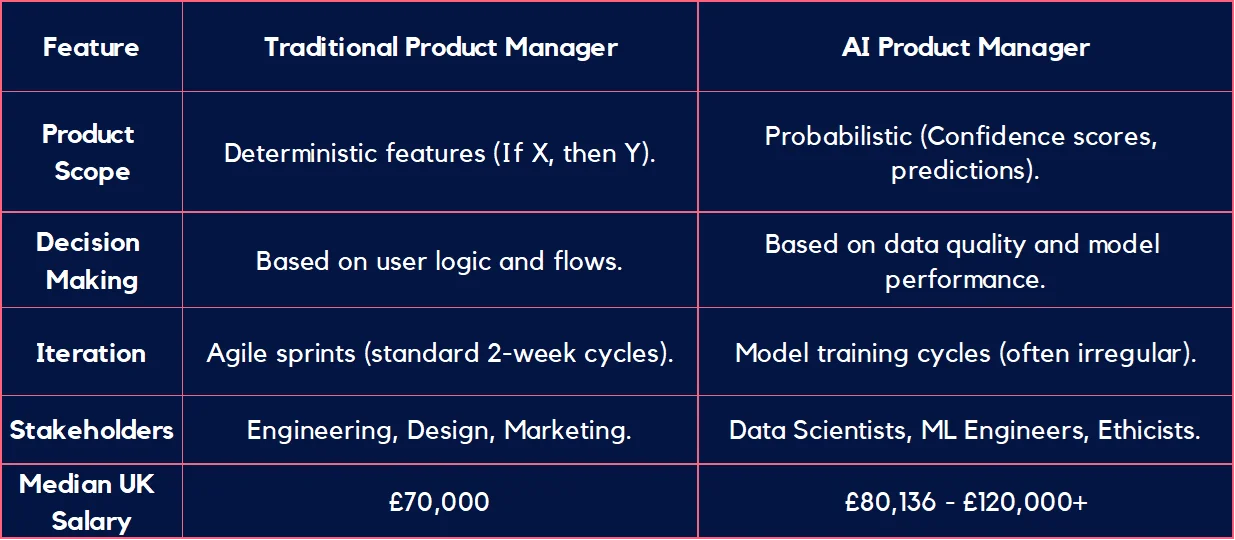 Table: Comparison of traditional product manager jobs and AI product manager jobs, including scope, responsibilities, and UK salaries
Which PM Skills Transfer to AI Roles?
For candidates exploring product manager jobs in 2026, moving into AI product manager jobs can feel daunting. However, many of the core skills that define strong product leaders remain directly transferable.
You do not need a PhD to pivot. The following traditional skills are vital:
- User Empathy: AI often "hallucinates." A strong PM knows how to design UI/UX that handles these errors gracefully for a British user base that values reliability.
- Stakeholder Management: Translating "business needs" into "technical requirements" is even more critical when the technical requirements involve "black box" algorithms.
- Strategic Vision: AI is expensive. Product recruitment specialists look for candidates who can determine if AI is actually necessary or if a simple rule-based system would suffice.
Our ultimate interview prep guide for product managers breaks down how UK employers evaluate product capability in practice.
Critical Upskilling Areas for AI Product Manager Jobs
To be competitive for AI product manager jobs, candidates should focus on two key areas:
- Data Literacy: Understanding how training, validation, and test datasets differ, and why data quality directly influences model performance and product outcomes.
- Metric Fluency: Knowing how metrics such as precision and recall affect real-world user experience, trade-offs, and product decision-making.
How AI Jobs Are Changing Product Manager Careers
The career ladder in the UK is branching. In our recent work placing candidates across London and Manchester, we’ve observed that "AI capability" has become a premium tier within product jobs.
Organisations are no longer siloing AI. This means product recruitment is surging for roles like Platform PMs (building AI infrastructure) and Applied AI PMs (integrating LLMs into existing user flows). For candidates, early exposure to these lifecycles impacts long-term career optionality. A Head of Product in 2028 will likely require a track record of shipping ML-driven features.
What This Means for Product Recruitment
Hiring for these roles is notoriously difficult. The overlap between "commercial acumen" and "AI technical literacy" is a small sliver of the UK talent market.
Product Recruitment Trends Shaping AI Roles in 2026
Recent trends show a clear divergence in the tech hiring market:
- Demand Surge: While general tech hiring remains measured, postings for AI-linked roles in the UK are projected to grow by 32% year-on-year in 2026.
- The Salary Premium: AI Product Managers in the UK command a 25-35% salary premium over generalist roles, with senior specialists in London often exceeding £120,000.
- The Risk of Failure: Industry data suggests that 40% of AI product initiatives fail due to poor problem definition, a direct result of hiring PMs who lack data fluency.
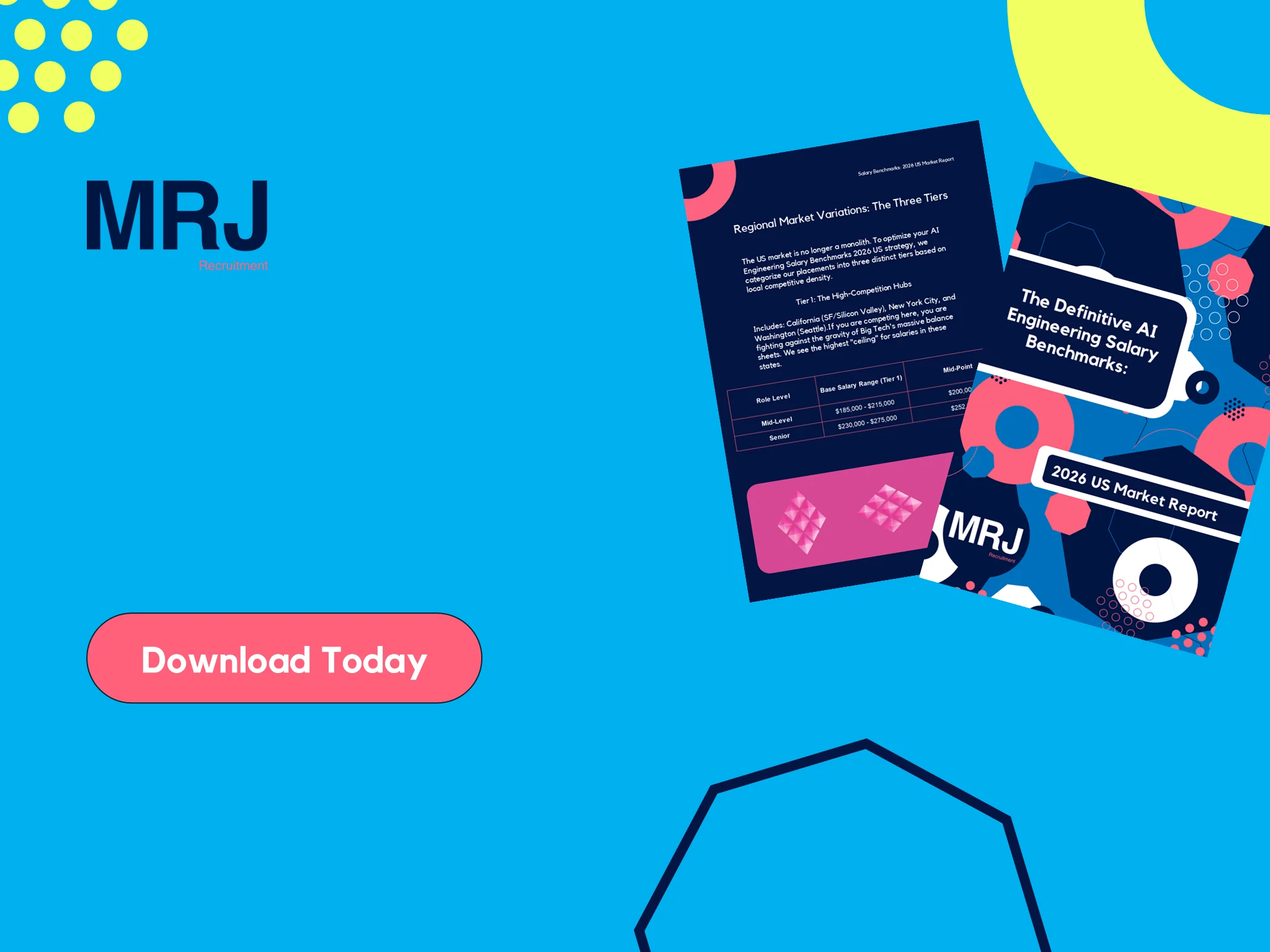
For a broader view of how AI roles are being valued globally, see our AI engineering salary benchmarks for 2026, which detail compensation trends across senior AI positions in the US
The Value of Specialist Product and AI Recruitment
In AI recruitment, generic keyword matching fails. You need to assess if a candidate understands the implications of AI, not just the buzzwords. We focus on finding leaders who can define problems clearly before a single line of code is written.
Are you struggling to find that rare blend of commercial acumen and AI fluency in the UK market? MRJ's product division
Hiring AI Product Managers: What UK Employers Need to Know
When to Hire an AI PM vs. Traditional PM
Don't hire an AI PM if you are just using a basic API wrapper. A strong traditional PM can handle that. Hire an AI Product Manager when the core differentiator of your product is the model itself, requiring constant tuning, data strategy, and ethical oversight.
Common Hiring Missteps
- Ignoring Soft Skills: Over-indexing on math skills often leads to products that work technically but fail commercially.
- Underestimating Ethics: Especially in tech-for-good recruitment, hiring leaders who understand bias in data is non-negotiable for brand safety in the UK’s regulated environment.
FAQs
Are AI jobs replacing traditional product manager jobs?
No, but they are evolving them. AI is automating administrative tasks like writing ticket descriptions, allowing PMs to focus more on strategy. However, according to recent
What experience is needed to move into AI jobs?
Experience in data-heavy sectors like fintech or healthtech is a great bridge. Candidates should demonstrate they have managed a product where "data" was the primary asset, not just a byproduct.
What skills do employers look for in an AI product manager?
UK employers prioritise technical fluency (communicating with data scientists), risk management (understanding hallucination risks), and user-centricity (translating complex outputs for non-technical users).
What are common mistakes in AI recruitment for product teams?
The biggest mistake is hiring for "AI experience" without a definition. Managing a proprietary model training lifecycle is a vastly different skill set from simply integrating a third-party LLM. Clear, outcome-based job descriptions are vital.
Your Next Step: Hiring AI Product Talent With MRJ Recruitment
The rise of AI product manager jobs represents the maturation of the UK tech sector. We are moving from "building code" to "teaching systems." For employers, the challenge is accurately scoping the role to attract the right talent. For candidates, the challenge is upskilling to meet the demands of probabilistic products.
Ready to secure the talent that will drive your AI strategy?
- Audit your current gaps: Do you need a prompt engineer or a strategic AI Product Manager?
- Review your EVP: Does your company culture attract high-level AI talent?
- Schedule a Consultation: Contact MRJ Recruitment today to discuss your product recruitment and AI recruitment strategy.
For a deeper look at how AI is reshaping the broader product career landscape and why the line between product and engineering is blurring in major tech hubs, see our analysis on how AI is shifting product management toward product engineering.
Author Bio
Lauren is a Multi-disciplinary Content Specialist at MRJ Recruitment, a leading UK tech recruitment firm. With extensive experience in the London and Manchester tech hubs, Lauren provides deep insights into AI recruitment and product trends. He also works closely with Talego, MRJ’s sister company, focusing on tech-for-good recruitment to ensure that the next generation of UK AI leaders prioritises ethics and social impact.